
Ask ten homeowners in Delaware County what a chimney flue is and you will get ten different answers. Some point at the brick stack on the roof. Some describe the metal pipe behind the furnace. Some use the word interchangeably with liner or chimney. That confusion matters more than it sounds, because almost every serious chimney problem our team finds in Drexel Hill, Havertown, Springfield, Media, and along the Main Line traces back to the flue doing something it was never designed to do.
Lou Curley’s Chimney Service has spent decades looking down flues in this housing stock: century-old twins and stone colonials, mid-century ranchers, and newer homes with factory-built fireplaces. This guide explains what the flue is, how the common types fail, and what to look for now, before the first cold night makes the fireplace or furnace a priority. Lou Curley is Pennsylvania’s first CSIA Master Chimney Sweep and an NFI Master Hearth Professional, and our team holds certifications through CSIA and F.I.R.E.
What a Chimney Flue Actually Is
The flue is the passage that carries combustion byproducts from an appliance out above the roofline. It is the working channel inside the chimney, not the chimney itself. A chimney stack in an older Delaware County home often contains more than one flue, typically one serving the fireplace and one serving the furnace or boiler. Whether a given flue can serve more than one appliance depends on the appliances, the fuel, and how the venting was designed. Utility flues that vent more than one appliance are common in this housing stock.
A flue has one job, and it is a demanding one. It has to keep hot gas, moisture, and acidic condensate inside a sealed path, keep that heat away from the wood framing around the chimney, and maintain enough draft to pull the next volume of gas out. When that chain breaks down, the symptoms show up in the living room as smoke, odor, or a fire that will not stay lit.
Flue, Liner, and Chimney Are Not the Same Word
The chimney is the structure. The flue is the passage inside it. The liner is the material forming the walls of that passage, whether clay tile or stainless steel. A chimney can have more than one flue, and a flue is only as sound as the liner around it. Getting these terms straight makes an inspection report far easier to read, and makes it harder for a homeowner to be sold work they do not need.
The Flue Types Found in Delaware County and Main Line Homes
Most of the flues our team encounters fall into three categories, summarized below.
| Flue type | Where it usually shows up | How it typically fails | What that means for the homeowner |
|---|---|---|---|
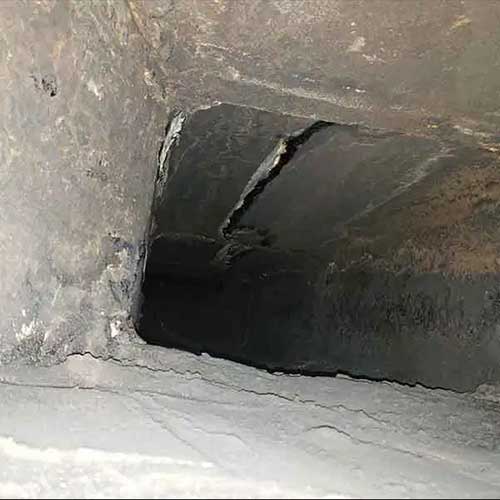
| Clay tile liner | Masonry chimneys in older homes throughout Drexel Hill, Havertown, and Media | Tiles crack, mortar joints between tiles wash out, and sections spall after long water exposure | Gaps let heat and combustion gas reach framing; a relining conversation usually follows |
| Stainless steel liner | Retrofits, furnace and boiler conversions, and homes where a clay flue has already failed | Generally durable when correctly specified and installed; issues are most often found at the top termination | Carries a transferable lifetime warranty when installed by our team |
| Factory-built metal flue | Prefabricated fireplaces in newer construction and additions | Corrosion at joints, crushed or separated sections, and missing manufacturer-specified components | Repairs must follow the manufacturer’s listing; substitute parts are not acceptable |
Clay Tile Flues and Water
Clay tile is durable and handles heat well, but it does not forgive water. A cracked crown or a missing cap lets rain sit inside the flue, and a Delaware County winter opens those cracks a little wider every year. By the time a homeowner notices staining on the chimney breast or a musty odor in July, the liner has usually been taking on water for seasons.
Stainless Steel Flue Liners
When a clay flue is beyond repair, a stainless steel liner is the standard answer. The right liner for a given chimney depends on the appliance, the chimney itself, and the manufacturer’s requirements, which is why an accurate diagnosis has to come before any quote. Lou Curley’s Chimney Service does not install aluminum liners or cast-in-place liners. Relining costs fall into two broad groups. Furnace and boiler liners generally run $2,500 to $4,500. Fireplace liners can run up to $17,000 depending on the chimney and the scope of the work.
Why the Flue Has to Match the Appliance
The relationship between an appliance and the flue it vents into is not something a homeowner can assess from the hearth. When that match is off, the symptoms tend to show up as a fireplace that smokes, a room that never quite warms up, or buildup inside the flue that accumulates faster than it should. Sorting out whether the flue suits the appliance is part of what an inspection is for, and it is one of the reasons a diagnosis has to come before a quote.
Warning Signs Worth Catching Before the First Cold Night
None of the following confirms a specific defect on its own, but any of them is a reason to have the flue looked at:
- Smoke rolling back into the room when the fireplace is lit and the damper is fully open
- A persistent musty or campfire odor from the fireplace during warm, humid weather
- White staining, flaking, or dampness on the chimney breast or the wall beside it
- Pieces of clay tile, mortar, or masonry debris found in the firebox or the ash dump
- A furnace or boiler that runs but produces an exhaust smell in the basement
- Rust on the damper assembly, the firebox, or the top of a metal appliance connector
- A carbon monoxide alarm that has sounded even once without an obvious explanation
That last one is not a maintenance item. If a carbon monoxide alarm sounds, leave the house and call 911 first.
What a Flue Inspection Involves
The NFPA standard is that chimneys are inspected annually and cleaned if necessary. Those are two separate questions, and reversing them is how homeowners end up paying for sweeping they did not need while a cracked liner goes unnoticed. Our technicians evaluate the liner condition, the flue size relative to the appliance, the crown and cap, the damper, the smoke chamber, and the clearances to combustible framing. Video scans are included with fireplace inspections, which is the only reliable way to document the interior condition of a flue that a homeowner will never see.
A Note on Safety and the Limits of Do-It-Yourself
Homeowners can and should watch for the symptoms above. They should not attempt to repair a flue, patch a liner, or open up a chimney to investigate. Flue work involves confined combustion passages, carbon monoxide risk, roof access, and clearance requirements that are set by code and by the appliance manufacturer. For any factory-built fireplace or gas heating appliance, always follow the manufacturer’s instructions and have a certified technician handle the diagnosis and the work. Note that Lou Curley’s Chimney Service does not perform gas fireplace repairs, though we do inspect, sweep, and reline the chimney and flue systems that serve heating appliances.
When Relining Is the Right Call
A cracked tile or two does not automatically mean the whole flue has to go. What matters is whether the passage can be made continuous and correctly sized again. If the liner has separated in multiple places, if clearance to framing is compromised, or if the flue is badly mismatched to the appliance, relining is the durable answer rather than a patch. If the fireplace has never drafted well and the problem is the relationship between the firebox, the smoke chamber, and the flue, a liner alone will not fix it, and Ahren-Fire restoration is usually the better route.
Scheduling Ahead of the Fall Rush
Every year the phone volume in Delaware County and along the Main Line climbs the week the temperature drops, and the homeowners who wait until then are the ones who go without a fireplace in November. Late summer and early fall are the easiest time to get on the schedule. We perform liner work throughout the heating season, but masonry repair is what becomes weather dependent once it gets cold, so anything involving the crown, the flue opening, or the structure itself is best handled before then.
Not sure what condition your flue is in? Lou Curley’s Chimney Service inspects, sweeps, and relines chimney and heating flues throughout Delaware County and the Main Line, from Drexel Hill and Havertown to Media, Springfield, Wayne, and Bryn Mawr. Contact us to schedule your annual inspection before the fall calendar fills.
Frequently Asked Questions
Q: What is the difference between a chimney flue and a chimney liner?
A: The flue is the passage that carries exhaust out of the home. The liner is the material forming the walls of that passage, usually clay tile or stainless steel. A chimney is the whole structure and can contain more than one flue, such as one for a fireplace and one for a furnace.
Q: How do I know if my chimney flue is cracked?
A: You usually cannot confirm it from inside the home. The common clues are pieces of clay tile in the firebox, staining on the chimney breast, a smoky fireplace, or a persistent odor. Confirming a crack requires an inspection, and on fireplace inspections our team documents the interior with a video scan.
Q: Does every chimney need its flue swept every year?
A: No. The NFPA standard is that chimneys are inspected annually and cleaned if necessary. How much a flue is used, what fuel it burns, and how it is drafting all determine whether sweeping is actually needed that year. The annual inspection is what answers that question.
Q: Can more than one appliance share a flue?
A: Sometimes. A fireplace and a furnace are normally on separate flues, but utility flues that vent more than one appliance are common in older Delaware County homes and are not automatically a defect. Whether a shared arrangement is correct depends on the appliances, the fuel, and how the venting was designed, which is one of the things an inspection evaluates.
Q: What does chimney flue relining cost in Delaware County?
A: It depends on what is being lined. Furnace and boiler liners generally run $2,500 to $4,500. Fireplace liners can run up to $17,000 depending on the chimney, the appliance being vented, and the scope of any related repair. A stainless steel liner carries a transferable lifetime warranty.
Q: When is the best time to have a chimney flue inspected?
A: Late summer and early fall, before the heating season starts. Scheduling is easier, and if the inspection turns up work that needs doing there is time to complete it first. We do liner work throughout the heating season, but masonry repair becomes weather dependent once it gets cold.